

1. Introduction to EPS Raw Materials and Thermal Conductivity
1.1 What is Expanded Polystyrene (EPS)?
EPS is a closed-cell rigid foam derived from styrene monomers, polymerized into polystyrene (PS) resin. Its production involves two stages: pre-expansion (impregnating PS beads with a blowing agent like pentane, which vaporizes and expands beads when heated) and molding (fusing pre-expanded beads into a uniform, closed-cell foam).
EPS raw materials consist of 90–95% PS resin, 2–5% blowing agents, and 1–3% additives (flame retardants, nucleating agents, stabilizers). Its 98% air/2% polystyrene composition—with closed cells trapping gas—is key to insulation, minimizing heat transfer via conduction, convection, and radiation.
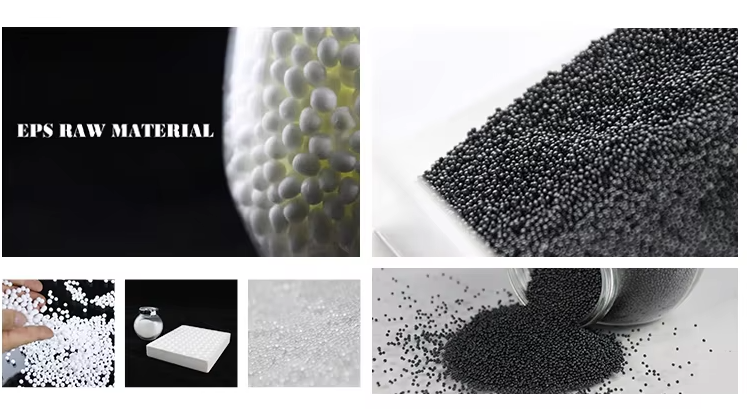
And EPS Raw Materials for construction should have suitable lambda.
1.2 Defining Thermal Conductivity
Thermal conductivity (λ, lambda) measures heat transfer rate per unit area and temperature gradient, expressed in W/m·K; lower values mean better insulation. A material with λ=0.03 W/m·K conducts heat half as fast as one with λ=0.06 W/m·K.
For EPS, heat transfer occurs via three modes: conduction (molecular collisions), convection (gas movement in cells), and radiation (electromagnetic waves). Closed cells minimize convection, while low-conductivity PS and trapped gas reduce conduction; graphite additives further lower radiative transfer.
1.3 Why Thermal Conductivity Matters for EPS Applications
Thermal conductivity directly impacts end-product energy efficiency. In construction, low λ reduces heating/cooling costs, allowing thinner insulation layers to save material and space. In cold storage, it stabilizes temperatures, lowering refrigeration loads. In packaging, it protects temperature-sensitive goods. Optimizing λ ensures performance, compliance with energy standards, and reduced environmental impact.
2. Key Factors Influencing the Thermal Conductivity of EPS Raw Materials
EPS thermal conductivity is not fixed; it depends on material composition, manufacturing processes, and environmental conditions. Below is a detailed breakdown of critical factors:
2.1 Raw Material Composition
2.1.1 Polystyrene Resin Quality
PS resin’s molecular weight, polymerization degree, and purity affect foam structure. High-molecular-weight resins create stronger, uniform-cell foams, reducing heat transfer. Impurities (residual monomers, contaminants) disrupt closed cells, increasing gas permeability and λ. High-purity resin is critical for optimal insulation.
2.1.2 Blowing Agents
Blowing agents (pentane, cyclopentane, HFCs, HFOs) create closed cells; their type and concentration impact λ. Hydrocarbons like cyclopentane have lower λ than air (0.026 W/m·K at 20°C), trapping them reduces heat transfer. Environmental regulations drive adoption of low-GWP HFOs/HFCs. Excess blowing agent causes cell rupture, increasing λ; optimal concentration balances cell size and integrity.
2.1.3 Additives
Additives modify EPS properties and λ:
·
Flame Retardants: Necessary for fire safety (e.g., magnesium hydroxide). Some disrupt closed cells or increase density, raising λ; non-brominated options are preferred for minimal thermal impact.
·
·
Nucleating Agents: Talc or calcium carbonate promote small, uniform cells, reducing convection and λ while enhancing mechanical strength.
·
·
Graphite Additives: Reduce radiative transfer (30% of total heat transfer), lowering λ by 10–15% (down to 0.030 W/m·K) in graphite-enhanced EPS.
·
·
Stabilizers: Antioxidants/UV stabilizers prevent resin degradation, maintaining closed cells and long-term thermal performance.
·
2.2 Foam Structure and Morphology
Cell size, distribution, wall thickness, and closed-cell content are critical. Uniform, small cells (0.1–0.5 mm) minimize convection and enhance conductive resistance; irregular cells create heat pathways. High closed-cell content (≥90%) traps gas effectively; incomplete molding causes open cells, increasing λ. Optimal cell wall thickness balances conductive resistance and gas volume.
2.3 Density of EPS
EPS density (10–35 kg/m³ for most applications) has a non-linear relationship with λ. λ decreases with density until a critical point (≈10 kg/m³); below this, thin cell walls rupture, increasing λ. Optimal density (15–25 kg/m³) yields λ=0.030–0.045 W/m·K; engineering uses 16–25 kg/m³ (λ=0.033–0.041 W/m·K), with variations from raw material and processing differences.
2.4 Environmental Conditions
Temperature, humidity, and aging affect λ:
·
Temperature: λ increases with temperature (0°C: ≈0.030 W/m·K; 40°C: ≈0.038 W/m·K), critical for extreme-climate applications.
·
·
Humidity: EPS is hydrophobic, but compromised closed cells allow moisture (λ=0.60 W/m·K) to increase λ by 33% at 10 vol% moisture. Water-resistant coatings mitigate this.
·
·
Aging: Blowing agent diffusion (replaced by air) increases λ by 5–10% over 10 years. UV stabilizers and protected installation minimize aging.
ISO 22007-2: A circular sensor heats and measures temperature on the sample surface. Faster (<1 minute), works for small samples; modified TPS (MTPS) with CT imaging achieves 2% deviation from real-world performance.
Conclusion
Thermal conductivity is the cornerstone of EPS’s insulation performance, shaped by raw material composition, foam structure, density, and environmental conditions. Standardized measurement methods (GHP, HFM, THW, TPS) ensure accurate λ assessment, while tailored formulations optimize EPS for construction, cold storage, packaging, and industrial use.
Recent advancements—nanofillers, sustainable blowing agents, precision manufacturing, and recycled EPS—drive EPS toward higher efficiency and sustainability. As global energy efficiency standards tighten, understanding and optimizing EPS thermal conductivity will remain critical for developing cost-effective, eco-friendly insulation solutions, cementing EPS’s role in the future of sustainable construction and industry.
Our EPS Raw Materials for construction is with high quality. And there are two colors in the EPS Raw materials for construction. Fuel blocking material(White EPS Raw Materials for construction ) and Graphite material(Black EPS Raw Materials for construction)
Contact me for EPS Raw Materials for construction
