From Raw Beads to Sustainable Solutions: Inside the World’s Most Versatile Polymer Production
Introduction: The Quiet Giant of Modern Manufacturing
In the global landscape of materials science, few innovations have quietly reshaped industries as profoundly as Expanded Polystyrene (EPS). From the protective packaging that safeguards electronics during transoceanic shipping to the energy-efficient insulation panels that reduce residential carbon footprints, EPS is a cornerstone of modern life. Yet, the critical pre-foaming stage that transforms raw EPS resin into a lightweight, rigid, and thermally stable material remains a closely guarded manufacturing art. As global demand for sustainable, cost-effective materials surges, understanding the science behind EPS pre-foaming has never been more critical. This report explores the technical intricacies of the process, its environmental evolution, and the industry’s race to balance performance with planetary responsibility.
The Foundation: What is EPS, and Why Does Pre-Foaming Matter?
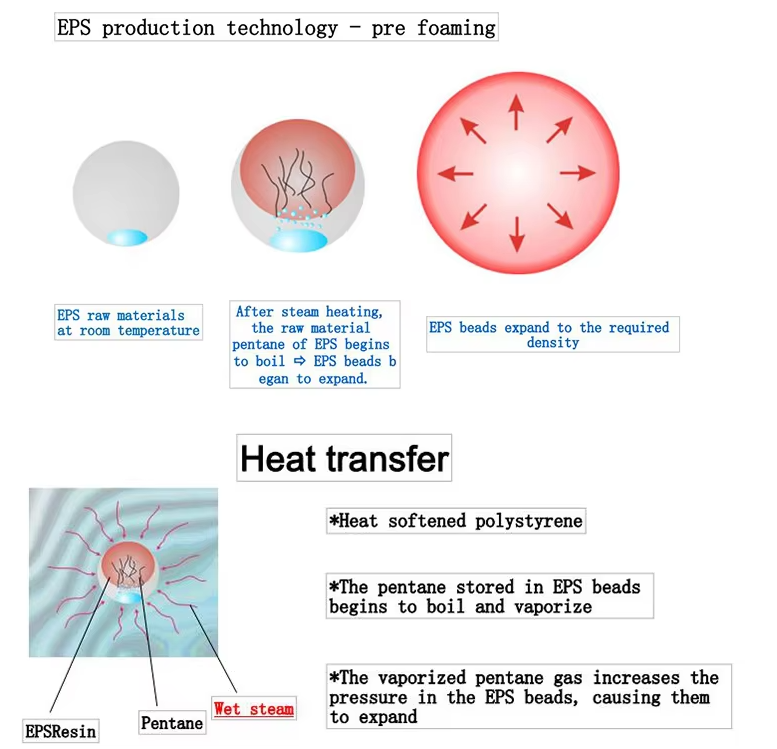
EPS begins as a deceptively simple raw material: polystyrene resin beads infused with pentane, a hydrocarbon blowing agent. At room temperature, these beads are dense, brittle, and uniform, measuring just 0.2–2.0 millimeters in diameter. Their true potential, however, is unlocked through pre-foaming—a thermal transformation that turns compact resin into a cellular, foam-like structure with up to 50 times its original volume.
“Pre-foaming is the DNA of EPS performance,” explains Dr. Elena Marquez, a materials science researcher at the Technical University of Munich. “The density achieved during this stage directly dictates the end product’s strength, insulation value, and durability. A packaging application might require a low-density foam for shock absorption, while construction insulation demands a denser matrix for structural integrity.”
This delicate balance starts with raw material preparation. Modern EPS manufacturers source virgin polystyrene resin from petrochemical feedstocks, though the industry is increasingly integrating post-consumer recycled (PCR) content. Each bead is impregnated with pentane under high pressure, a process that ensures the blowing agent is evenly distributed within the polymer matrix. This uniformity is non-negotiable: inconsistencies in pentane concentration lead to uneven expansion, resulting in weak spots or structural failure in the final foam.
The Pre-Foaming Process: A Symphony of Heat, Pressure, and Precision
The pre-foaming stage unfolds in specialized steam-heated vessels, where raw EPS beads undergo a controlled metamorphosis. Here’s a step-by-step breakdown of the industrial process:
1. Loading and Initial Conditioning
Raw EPS beads are loaded into a vertical pre-foamer, a cylindrical vessel capable of holding up to 5,000 kilograms of material. Before heating begins, the chamber is purged with low-pressure steam to remove ambient air, ensuring uniform heat transfer. This initial conditioning prevents cold spots that could disrupt expansion.
2. Steam Injection and Softening
Wet, saturated steam is introduced into the vessel, raising the internal temperature to approximately 100°C. As heat penetrates the polystyrene beads, the polymer chains soften, transitioning from a rigid glassy state to a flexible, rubbery phase. This thermal softening is critical: it allows the bead to stretch without rupturing as internal pressure builds.
3. Pentane Vaporization and Expansion
As temperatures rise, the pentane trapped within each bead reaches its boiling point (36.1°C for n-pentane). The liquid blowing agent vaporizes, expanding rapidly and creating internal pressure that pushes against the softened polystyrene walls. The beads swell uniformly, their volume increasing by a factor of 10–50 depending on the target density.
“The physics here are elegant,” says Dr. Marquez. “It’s a perfect example of phase change driving material transformation. The pentane vapor acts like millions of tiny balloons, inflating the polymer matrix into a closed-cell foam structure.”
4. Drying and Stabilization
Once the desired expansion is achieved, the foam beads are discharged from the pre-foamer and transported to a drying silo. Over 24–48 hours, residual moisture evaporates, and the polystyrene chains relax, locking the cellular structure into place. This stabilization period ensures the beads maintain their expanded size during subsequent molding processes.