Expanded Polystyrene (EPS) is a versatile material widely used in construction insulation, cold chain logistics, packaging, and other fields. Its performance directly determines the quality, safety, and durability of end products. However, the market is flooded with EPS raw materials of varying quality, making it crucial for manufacturers, contractors, and buyers to master effective identification methods. This guide integrates practical observation techniques and professional testing standards to help distinguish high-quality EPS raw materials from inferior ones.
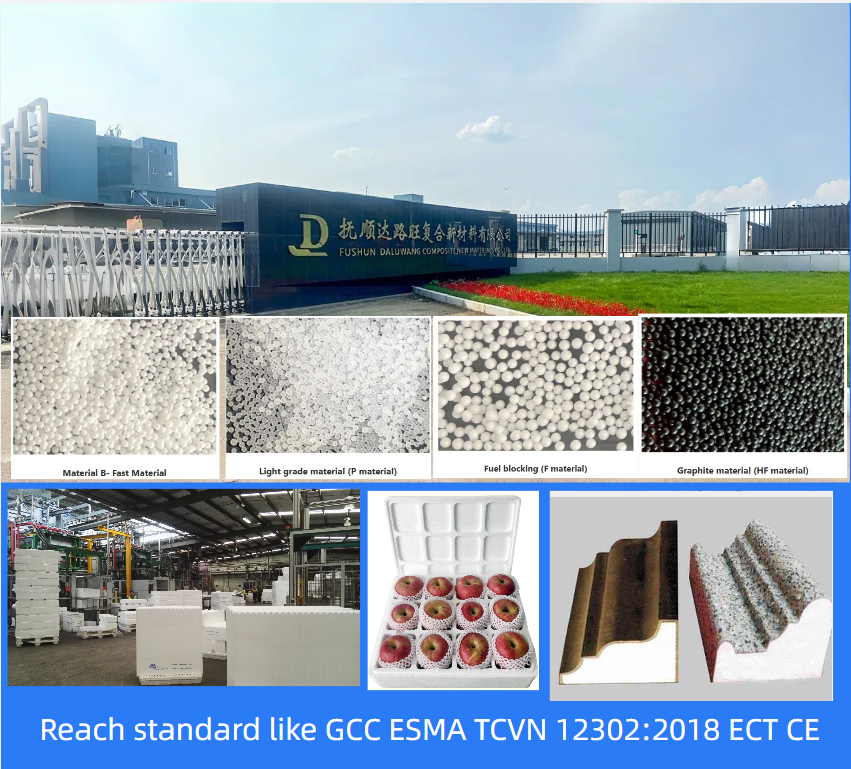
Preliminary Identification: Visual Inspection of Raw Pellets
The first step in evaluating EPS raw material quality is a thorough visual inspection of the pellets before processing. This simple yet effective method can screen out obvious inferior products.
Uniformity of Particles: High-quality EPS Beads should have consistent particle size, with no extreme variations between individual beads. The absence of unusually large or small particles indicates strict quality control during production. Uneven particle sizes often lead to inconsistent expansion and poor molding performance, affecting the final product's structure stability.
Particle Shape and Cleanliness: Premium EPS pellets are typically rounded, avoiding irregular shapes such as ellipses or polygons that hinder uniform expansion. Additionally, the pellets should be clean and free of impurities, dust, or discoloration. Transparent or milky white pellets are preferable to yellowish or tea-colored ones, as discoloration may indicate degradation or impure raw materials.
Key Assessment: Performance During Pre-Expansion
Pre-expansion is a critical stage that reflects the core performance of EPS raw materials. Observing the behavior of pellets during this process can effectively identify their quality.
Expansion Speed and Agglomeration Resistance: High-quality EPS raw materials expand rapidly and do not easily clump together. Slow expansion or frequent agglomeration not only reduces production efficiency but also signals poor foaming agent distribution within the pellets. The ideal expansion process should be smooth, with each pellet expanding independently.
Expansion Multiplier Adjustability: Superior EPS materials allow for easy and stable adjustment of the expansion multiplier. This flexibility enables manufacturers to produce products of different densities to meet diverse application needs. Unstable adjustability often results in inconsistent product specifications and performance.
Foam Particle Quality: After pre-expansion, high-quality foam particles should be dry, loose, and free of static electricity, ensuring good fluidity in subsequent processing. The internal pores should be uniform in size and mature quickly—fine, dense pores enhance thermal insulation performance by reducing heat transfer through conduction and radiation.
Final Verification: Molding Stage Performance
The molding stage provides the final verification of EPS raw material quality, as it directly reflects how the material performs in actual production.
Molding Conditions and Efficiency: High-quality EPS raw materials have a wide range of controllable molding conditions, ensuring good mold filling and easy demolding. This not only simplifies the production process but also reduces defective products caused by poor molding. Difficult mold filling or frequent sticking to molds often indicates inferior raw materials.
Finished Product Quality: Molded products made from premium EPS should have a glossy appearance, high fusion rate between particles, and excellent mechanical strength. A low fusion rate leads to weak structural integrity, while poor strength results in easy damage during transportation or use.
Dimensional Stability: Superior EPS products exhibit good dimensional stability, recovering easily after slight shrinkage. According to GB/T 10801.1-2021, the dimensional change rate of EPS materials should not exceed 2% after 48 hours at 70±2℃ and 1% after 24 hours at -30±2℃ . Poor dimensional stability causes cracking or deformation in insulation layers or packaging, affecting their functionality.
Professional Testing Indicators for Strict Quality Control
For large-scale production or high-demand applications, professional testing is essential to ensure EPS raw materials meet national and industry standards. Key testing indicators include:
Apparent Density: The optimal density range for EPS materials is 30-40 kg/m³, where thermal insulation performance is balanced with mechanical strength. The density deviation should not exceed ±2 kg/m³ from the nominal value.
Thermal Conductivity: A lower thermal conductivity indicates better insulation performance. For EPS with a nominal density ≥20 kg/m³, the thermal conductivity (λ) should be ≤0.041 W/(m·K) .
Water Absorption: After 96 hours of immersion, the water absorption rate should be ≤4% (volume absorption ≤2%). High water absorption significantly reduces insulation performance and accelerates material aging.
Compressive Strength: EPS materials should have a compressive strength ≥100 kPa when compressed to 10% deformation, ensuring they can withstand construction loads and long-term stress.
Environmental and Safety Indicators: The residual pentane content should be ≤1.5%, and VOC emissions must comply with GB 50325-2020. For flame-retardant applications, EPS should reach B1 grade, with an oxygen index ≥30% and smoke density grade ≤75.
Conclusion: A Holistic Approach to Quality Assurance
Distinguishing high-quality expanded polystyrene requires a combination of visual inspection, process observation, and professional testing. By focusing on particle uniformity, pre-expansion performance, molding stability, and compliance with technical standards, industry professionals can avoid inferior materials and ensure product quality. Establishing a full-process quality control system—from raw material incoming inspection to finished product testing—and cooperating with third-party testing institutions further enhances reliability.
In a competitive market, choosing high-quality expandable polystyrene is not only a guarantee of product performance but also a key driver of long-term business development.