

I. What is EPS foam insulation material? How is it "foamed"?
EPS stands for Expanded Polystyrene. To put it more simply, it is essentially a plastic material composed of countless closed small bubbles, and these "bubbles" are precisely the core of its insulation properties.
The production process of EPS is not complicated and can be roughly understood in three steps:
Pre-expansion: EPS raw material particles expand under the action of steam.
Curing and stabilization: Allowing the internal pressure of the particles to equalize.
Re-molding: Processing into sheets, shaped parts, or modules using molds.
Because of its highly closed-cell structure, air is firmly locked inside the particles, making it difficult for heat to conduct. This is the fundamental reason why EPS can provide stable insulation for a long time.
II. Why has EPS become a mainstream insulation material?
There are many insulation materials on the market, but EPS has been used for so many years not because it's "cheap," but because of its overall cost-effectiveness.
1. Stable insulation performance, not reliant on luck
The thermal conductivity of EPS remains stable over the long term and does not easily degrade over time. Especially graphite EPS, which further reduces heat conduction by incorporating infrared reflective materials.
2. Lightweight and structurally friendly
Compared to traditional insulation materials, EPS has a low density and is lightweight, which does not add extra burden to buildings or equipment.
3. Flexible processing methods
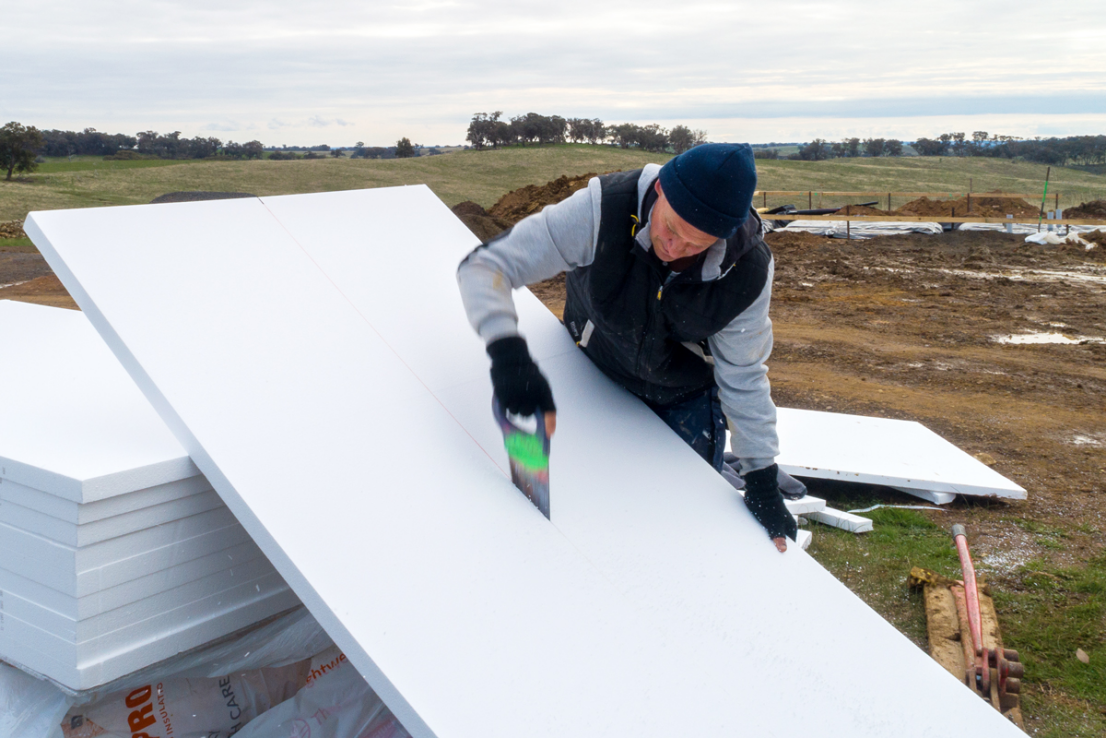
Cutting, thermoforming, and molding are all possible, which is why EPS can be used not only for panels but also for modules, irregularly shaped packaging, and cold chain containers.
4. Controllable cost, suitable for large-scale applications
For engineering projects, stable performance and reliable supply are often more important than "extreme parameters."
III. What are the differences between regular EPS and graphite EPS?
| Comparison Dimensions: | Standard White EPS | Graphite EPS |
| Appearance/Color | White | Gray / Dark Gray |
| Thermal Conductivity | Regular performance level, meets basic insulation needs | Lower thermal conductivity, better insulation performance at the same thickness |
| Insulation Performance | Stable and mature technology | Stronger, better heat reflection capability |
| Thickness Requirements | Usually requires a thicker layer to achieve the same effect | Superior performance at the same thickness |
| Applicable Scenarios | Packaging, basic insulation, general building applications | Suitable for exterior wall insulation, cold storage, and cold chain systems |
IV. Is the fire resistance reliable? This is a major concern for many engineering clients.
Regarding the fire resistance of EPS Graphite Polystyrene Raw Material products, there have been many misconceptions in the market. Many people, upon hearing "foam material," instinctively assume it's equivalent to flammable plastic. In reality, compliant EPS is not like that. Through a properly designed flame retardant system, EPS can achieve different fire resistance ratings. Our EPS products strictly adhere to national and industry standards, meeting B1 fire retardant requirements and complying with relevant regulations such as "GB 50016-2014 Code for Fire Protection Design of Buildings" and "GB/T 29906-2013 Combustion Performance of Thermal Insulation Materials." In practical engineering applications, as long as compliant products are used and the system structure is properly designed, EPS can be safely applied in scenarios with high safety requirements, such as exterior wall insulation, building insulation modules, and even fire door core materials.
Daruwin's factory capabilities determine the reliability of our deliveries.
Ultimately, EPS is not a disposable product, but a functional material for long-term use, making factory capabilities crucial.
Our production base boasts the following advantages:
• Large factory area and sufficient production capacity
• Annual production capacity of 240,000 tons
• Located near petrochemical raw material bases, ensuring a stable supply of raw materials
• Focus on R&D-driven innovation, enabling customized EPS granule solutions
• Strict quality control system for long-term stable supply
What we excel at is not simply "selling off-the-shelf products," but rather developing material solutions based on project requirements. This is why many overseas customers are willing to cooperate with us long-term.
